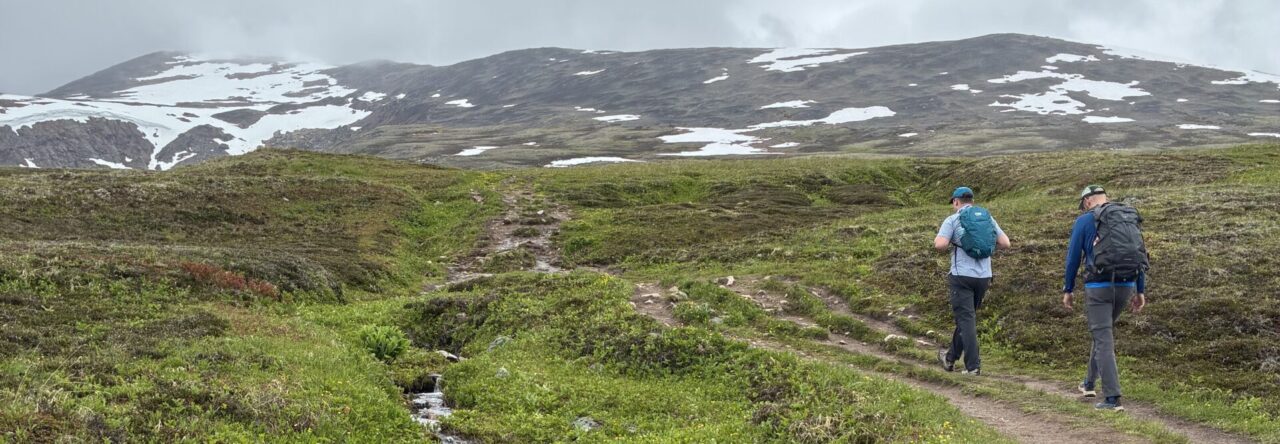
In this week’s class we went to West Lake Provincial Park. The core themes were place based learning, the First Peoples Principles of Learning, and walking curricula.
Connecting yourself to the land is a core part of the UNBC BEd program’s pedagogy of People, Place, and Land, and it is also something that I have found to be critical in my own learning. I try to relate my own learning to who I am, where I am, and the community I am a part of. Which is not to say that I am always learning contextually relevant things, but I do naturally connect things I’ve learned to my lived reality. I want to teach in a way that gives students the opportunity to connect their learning with their life and with the world around them. It is easy, especially as a math teacher, to hand out worksheets with context-less problems. It requires more of an effort for teachers to connect theory with reality, and it is even more effortful to teach in such a way that the students are inspired by those connections to notice and/or create their own connections. But it is well worth the effort because to foster a connection building mind is fundamental to developing a life long learner.
One of the activities we participated in was exploring the First People’s Principles of Learning. This involved a deep dive into a couple of the principles among smaller groups before sharing our ideas among the class as a whole. In my group we focused on the following two principles:
- Learning ultimately supports the well-being of the self, the family, the community, the land, the spirits, and the ancestors.
- Learning involves generational roles and responsibilities.
Our discussion was primarily about the connection between these two principles. That is, the importance of the involvement of community members and family in education. There is a lot to be gained by inviting members from the community who have knowledge in a certain area to come and share about their career, life path, or other valuable stories. This kind of educational event can broaden a students perception of possible life pathways as well as providing a more rich learning environment by having multiple voices teaching them.
The third and final theme of the class was about walking curricula. We went for a stroll around the park with specific questions to think about and discuss among a small group. What I took from this experience was a greater appreciation for the value of encouraging observation. I think of myself as an observant person, but when you are given a question that asks you to think of how you can know if something is moving with senses other than sight, you find yourself considering things from another angle all together. It was a delightful experience. Whether or not you are walking, the idea of supported curiosity is something I want to explore further. Which isn’t to say that I didn’t appreciate the walking. I did. It just wasn’t my biggest takeaway.
Leave a Reply