For the first half of today’s class we did the KAIROS blanket exercise. It was an informative experiential learning opportunity that led us through the Indigenous experience since colonialism.
The two main takeaways, for me, were that the Indigenous peoples were given no choice in all of the drastic restrictions imposed on them by settlers and the devastation caused by disease before most of those policies were even conceived. In the exercise, I was one of the large group of participants that had to leave the blankets — symbolizing death — as soon as the settlers came to Turtle Island. I learned in school that there was disease spread when colonizers encountered new people groups, but this exercise gave me a new appreciation for just how immense the devastation was. I also knew on an intellectual level that the Indigenous people were not consulted on the life changing decisions made by the Canadian government and churches of Canada, but through this exercise I had my eyes opened to just how affronting that is to someone’s dignity. The settler, played by our instructor, made all the decisions along with the narrator, and there was no freedom given to the participants representing the Indigenous people.
All told, the exercise was an emotionally charged learning experience that may take some time to fully sink in. I will probably connect things I learn in the future back to this because that is one of the best forms of learning. Among my emerging pedagogy is the idea that to connect theoretical learning with experiences and vice-versa is important for enriching understanding.
Then, in the second half of the class we began looking at BC’s curriculum. Our initial foray was discussing the vision for student success and the idea of an educated citizen. We talked about the need for teaching to provide students with the framework to navigate the world as it is, and that this means teaching not just content but also teaching with a healthy environment that focuses on students centred approaches and shapes them in to an educated citizen.
While this sounds like a good ideal, I believe that the definition of an educated citizen given by the provincial government is not inclusive of people with disabilities.
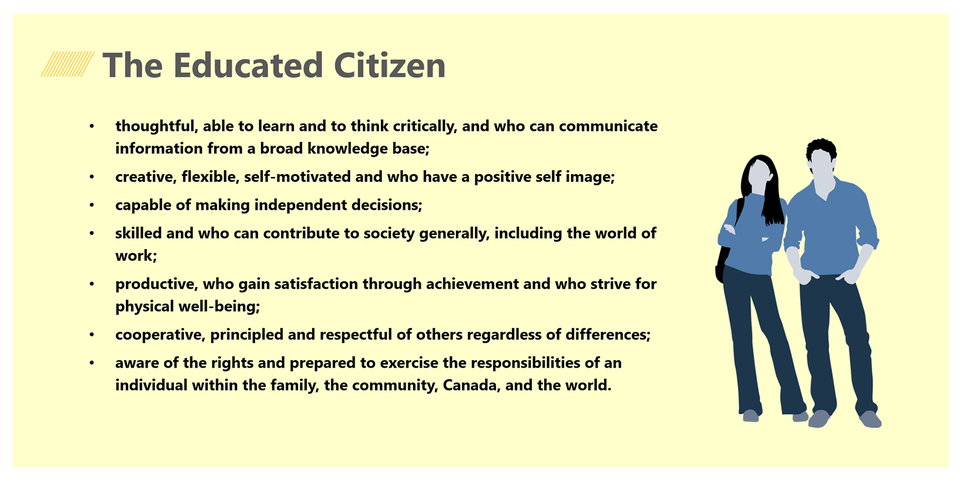
The two key bullet points that I find problematic are “skilled and who can contribute to society generally, including the world of work” and “productive, who gain satisfaction through achievement and who strive for physical well-being.” This first point I find challenging because to be a person who has value I do not think you need to be able to contribute to society through work, and I also do not think you need to be skilled to have worth as a human being. The second challenging point is very similar to the first. Do we need to have physically well people for them to be educated citizens. This is implying that you are not as valuable to the world if you are not wanting to be physically fit, and how does disability factor in to well-being? Now, I can imagine that the argument is that being an educated citizen or not isn’t commenting on your worth, but I would respond that in conjunction with the rest of the points, and given the wording choices, it seems to me to imply a value judgment. And because it is a government published statement I would suggest that it should be inclusive of all citizens. Suggesting that some citizens are uneducated citizens carries ill will that I do not believe is appropriate from the government.
I can appreciate the need to consider the students as whole beings that deserve our teaching to be a more full experience than simply about the content, and I also think that the choice of words are problematic for including everyone in that educational model. The current definition of an educated citizen is not far off of the idea of a model citizen, and in connection to the exercise in the first half of the class today, I see alarming similarities with the attempt to assimilate the Indigenous youth to the European way of being through residential schools.
Leave a Reply