Ben Van Bergeyk

A Digital Portfolio of My Learning in EDUC 394

Lesson Planning at Cottonwood Island Park

Our class this week was outdoors again. At Cottonwood Island Park we did some curriculum exploring and lesson planning. The primary focus was to plan a place-based learning activity that centres the land as a teacher which ties in to our assigned reading Decolonization is not a metaphor. This article focuses on the need to do more than just say the right things. The point of decolonizing isn’t to wipe away guilt but to value, prioritize, and protect the autochthonous was of knowing and being.

There is much to be said for the authors’ point that “decolonization is not accountable to settlers, or settler futurity,” but I also think that there room for pragmatic thinking which would consider the settlers as having a voice in how this moves forward. The authors suggest that reconciliation is not their goal. They differentiate reconciliation from decolonization which, to me, is a difficult separation to make. I get that there is a need for uncomfortable feelings for the colonizers, and I also think that they will not be willing to go there if they do not also have conversations about what the result of decolonization will look like for them. So, while I really appreciate the sentiment of the futility of symbolic gestures and our responsibility to do more, I also think that there is a need to approach this with a genuine effort of equal dialogue on both sides which means recognizing the futures of all parties.

The aspect that I appreciated from the article was around the metaphorical usage of reconciliation/decolonization words and phrases which are used to pacify the settler community without leading to changes in actions or treatments of the Indigenous people. This has been a big theme of our program so far. We can say that we are teaching about Indigenous people to satisfy curricular requirements and shoehorn Indigenous principles into our already fully-formed western lessons, and when we do that we may satisfy our own settler-guilt without actually changing our practices. That isn’t reconciling in good faith. To decolonize our education system is to create lessons that centre the Indigenous ways of knowing, and to build teaching practices that centre land-based, experiential, and relational learning as well as teaching the history and cultural knowledge, when granted permission.

So, the lesson planning the happened this week was informed by these ideas of good-faith reconciliation. My group created a grade 1 math lesson on patterns where the students would collect leaves and sort them based on things they noticed about the leaves. They would learn from the land concepts of similarities and differences among living things, and they would be able to experience their learning with hands-on math. Our goal wasn’t to satisfy our teacher-guilt; rather, we sought to focus on Indigenous principles of learning to create a land-based lesson.
Experiential Learning and the Problem With Our Educated Citizen Model

For the first half of today’s class we did the KAIROS blanket exercise. It was an informative experiential learning opportunity that led us through the Indigenous experience since colonialism.

The two main takeaways, for me, were that the Indigenous peoples were given no choice in all of the drastic restrictions imposed on them by settlers and the devastation caused by disease before most of those policies were even conceived. In the exercise, I was one of the large group of participants that had to leave the blankets — symbolizing death — as soon as the settlers came to Turtle Island. I learned in school that there was disease spread when colonizers encountered new people groups, but this exercise gave me a new appreciation for just how immense the devastation was. I also knew on an intellectual level that the Indigenous people were not consulted on the life changing decisions made by the Canadian government and churches of Canada, but through this exercise I had my eyes opened to just how affronting that is to someone’s dignity. The settler, played by our instructor, made all the decisions along with the narrator, and there was no freedom given to the participants representing the Indigenous people.

All told, the exercise was an emotionally charged learning experience that may take some time to fully sink in. I will probably connect things I learn in the future back to this because that is one of the best forms of learning. Among my emerging pedagogy is the idea that to connect theoretical learning with experiences and vice-versa is important for enriching understanding.

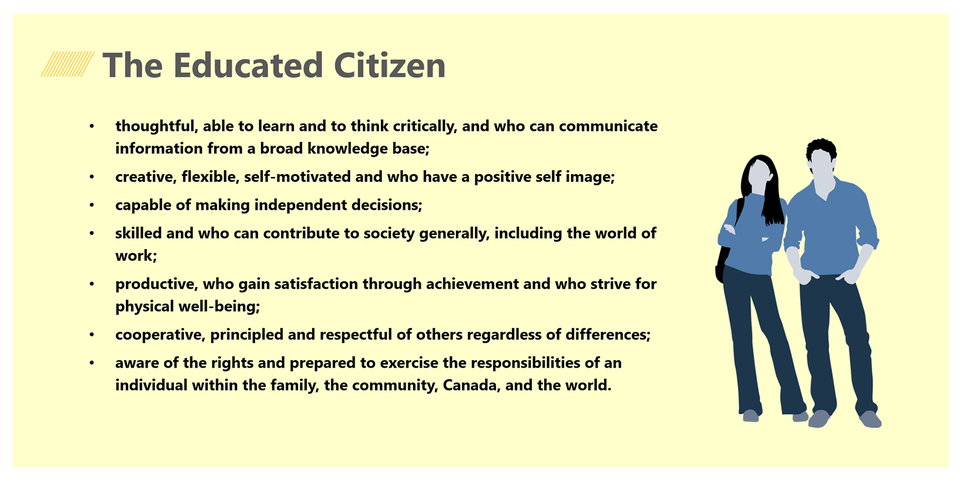
Then, in the second half of the class we began looking at BC’s curriculum. Our initial foray was discussing the vision for student success and the idea of an educated citizen. We talked about the need for teaching to provide students with the framework to navigate the world as it is, and that this means teaching not just content but also teaching with a healthy environment that focuses on students centred approaches and shapes them in to an educated citizen.

While this sounds like a good ideal, I believe that the definition of an educated citizen given by the provincial government is not inclusive of people with disabilities.

The two key bullet points that I find problematic are “skilled and who can contribute to society generally, including the world of work” and “productive, who gain satisfaction through achievement and who strive for physical well-being.” This first point I find challenging because to be a person who has value I do not think you need to be able to contribute to society through work, and I also do not think you need to be skilled to have worth as a human being. The second challenging point is very similar to the first. Do we need to have physically well people for them to be educated citizens. This is implying that you are not as valuable to the world if you are not wanting to be physically fit, and how does disability factor in to well-being? Now, I can imagine that the argument is that being an educated citizen or not isn’t commenting on your worth, but I would respond that in conjunction with the rest of the points, and given the wording choices, it seems to me to imply a value judgment. And because it is a government published statement I would suggest that it should be inclusive of all citizens. Suggesting that some citizens are uneducated citizens carries ill will that I do not believe is appropriate from the government.

I can appreciate the need to consider the students as whole beings that deserve our teaching to be a more full experience than simply about the content, and I also think that the choice of words are problematic for including everyone in that educational model. The current definition of an educated citizen is not far off of the idea of a model citizen, and in connection to the exercise in the first half of the class today, I see alarming similarities with the attempt to assimilate the Indigenous youth to the European way of being through residential schools.

Place, Community, and Observation at West Lake Provincial Park

In this week’s class we went to West Lake Provincial Park. The core themes were place based learning, the First Peoples Principles of Learning, and walking curricula.

Connecting yourself to the land is a core part of the UNBC BEd program’s pedagogy of People, Place, and Land, and it is also something that I have found to be critical in my own learning. I try to relate my own learning to who I am, where I am, and the community I am a part of. Which is not to say that I am always learning contextually relevant things, but I do naturally connect things I’ve learned to my lived reality. I want to teach in a way that gives students the opportunity to connect their learning with their life and with the world around them. It is easy, especially as a math teacher, to hand out worksheets with context-less problems. It requires more of an effort for teachers to connect theory with reality, and it is even more effortful to teach in such a way that the students are inspired by those connections to notice and/or create their own connections. But it is well worth the effort because to foster a connection building mind is fundamental to developing a life long learner.

One of the activities we participated in was exploring the First People’s Principles of Learning. This involved a deep dive into a couple of the principles among smaller groups before sharing our ideas among the class as a whole. In my group we focused on the following two principles:

  • Learning ultimately supports the well-being of the self, the family, the community, the land, the spirits, and the ancestors.
  • Learning involves generational roles and responsibilities.

Our discussion was primarily about the connection between these two principles. That is, the importance of the involvement of community members and family in education. There is a lot to be gained by inviting members from the community who have knowledge in a certain area to come and share about their career, life path, or other valuable stories. This kind of educational event can broaden a students perception of possible life pathways as well as providing a more rich learning environment by having multiple voices teaching them.

The third and final theme of the class was about walking curricula. We went for a stroll around the park with specific questions to think about and discuss among a small group. What I took from this experience was a greater appreciation for the value of encouraging observation. I think of myself as an observant person, but when you are given a question that asks you to think of how you can know if something is moving with senses other than sight, you find yourself considering things from another angle all together. It was a delightful experience. Whether or not you are walking, the idea of supported curiosity is something I want to explore further. Which isn’t to say that I didn’t appreciate the walking. I did. It just wasn’t my biggest takeaway.

Beaded Tweets

Incorporating Indigenous ways of knowing in to our practice as educators is an essential part of truth and reconciliation.

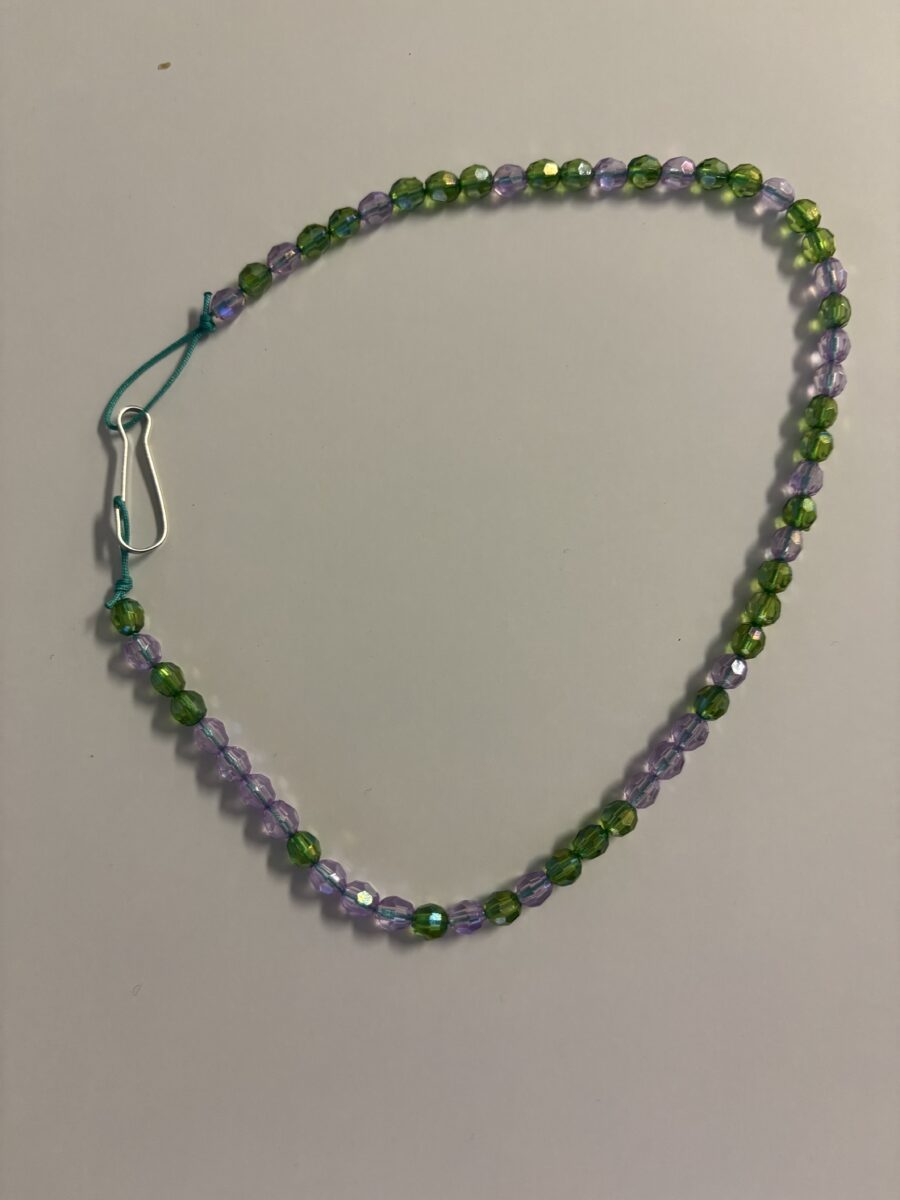
This class activity, called Beaded Tweets, was teaching coding through beading. Each bead represents a bit, and the string of beads is using eight-bit character codes to spell a word.

This connection is intriguing to me because I am interested in exploring alternative forms of math education, and it opens up ideas for me in terms of creating lesson plans that involve beading or other indigenous forms of artistic expression. One of these ideas is to incorporate story as a way to instruct in a more engaging manner as well as honouring the First Peoples Principles of Learning. In particular, “Learning is embedded in memory, history, and story.”

Powered by WordPress & Theme by Anders Norén